
Products
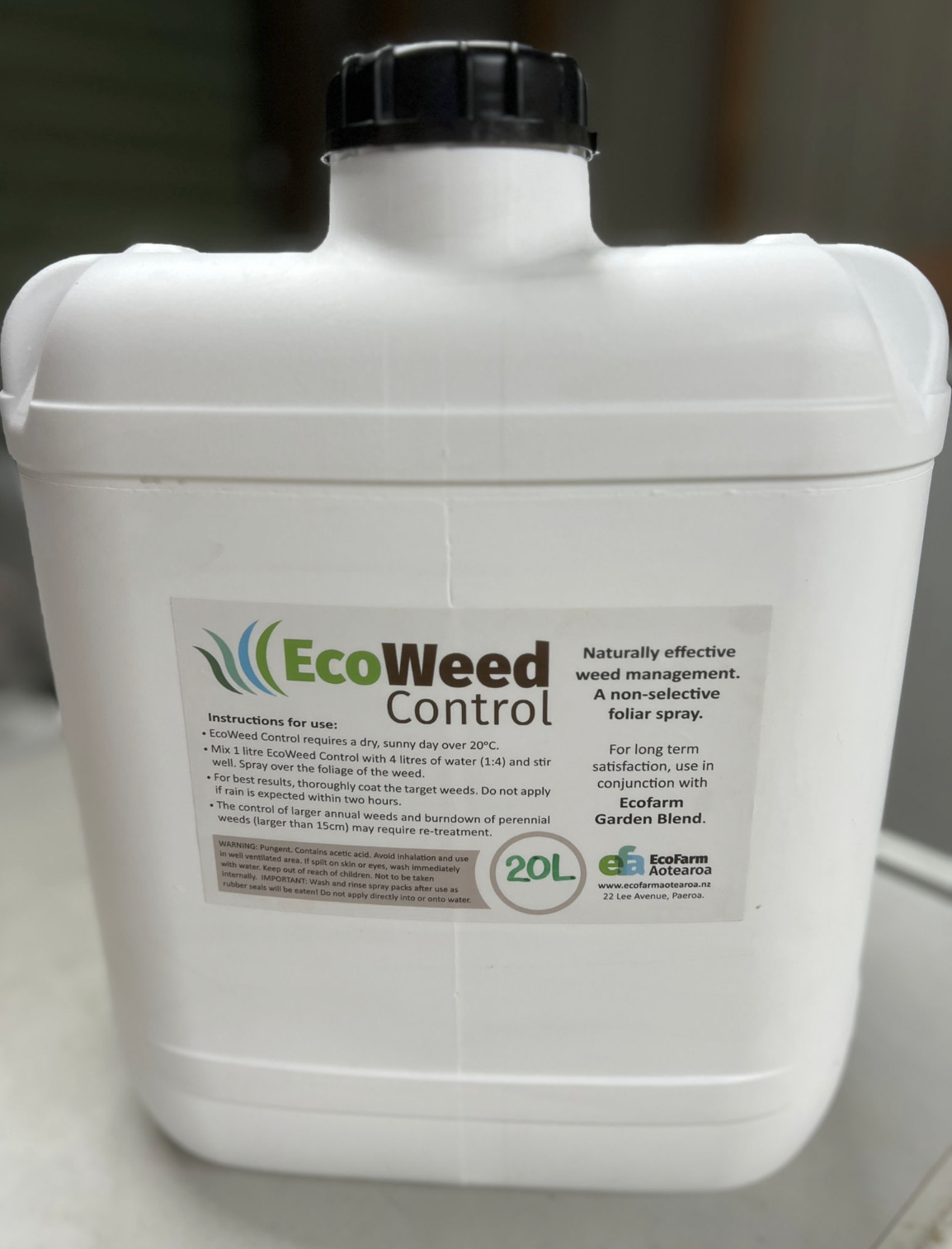
EcoWeed Control (previously Dead Grass)


Soil Building and Fertility
EcoWeed Control (previously Dead Grass)
Knock Back Weeds While Working With Your Soil, Not Against It
EcoWeed Control is a fast-acting, non-systemic herbicide alternative designed to assist with the control of weeds across farms, lifestyle blocks, orchards, and around the home.
It is acetic acid based, with additional components to enhance performance, and works by burning back plant tissue on contact rather than moving systemically through the plant.
You’ll typically see visible results quickly - often within 24–48 hours in suitable conditions.
Developed on Our Organic Trial Farm
EcoWeed Control was developed through use on our own organically managed trial farm, where protecting soil biology, water systems, and long-term soil function is a priority.
In most situations, we address weeds by improving soil function and fertility. As the environment changes, weed pressure typically reduces over time.
However, there are areas - such as gorse and blackberry on steeper or inaccessible ground - where fertiliser cannot be easily applied, and the soil environment remains unchanged.
EcoWeed Control was developed to manage these areas, providing a practical knockdown option that still fits within a soil-first system.
Weeds Are a Signal - Not Just a Problem
At Ecofarm, we don’t just look at the weed - we look at why it is there.
Weeds establish where the soil environment suits them. If that environment doesn’t change, the weed will keep coming back, no matter what you spray.
That’s why EcoWeed Control is used as part of a wider approach:
- Knock the weed back with EcoWeed Control
- Change the environment through soil improvement
That combination is where long-term shifts start to happen.
Gorse, Blackberry and Prickly Weeds
EcoWeed Control is commonly used on gorse, blackberry, Onehunga weed, and other prickly species.
In warm conditions, you’ll typically see a strong visual knockdown:
- Gorse often turns a pale grey/white
- Blackberry tends to blacken and burn back
Timing matters - particularly with blackberry. Spraying is generally more effective once the plant has moved past its vibrant green growth phase and begins to harden off later in the season.
But spraying alone isn’t the answer.
As soil fertility improves, the environment these weeds rely on begins to shift. In pasture situations, this can support better grazing underneath and reduce the dominance of these plants over time.
Lawn Prickles - A Practical Fix
Prickly weeds like Onehunga are a classic example of a soil imbalance showing up.
You can spray them - and you should - but if the soil doesn’t change, they’ll be back.
A practical approach:
- Improve the soil first (e.g. Garden Blend)
- Spray with EcoWeed Control (spot spray or broader application)
- Re-seed after a few days
- Keep the area watered (chlorine-free where possible)
This approach helps remove the existing weeds while improving conditions for more desirable grasses.
Kikuyu - Managing the Bully
Kikuyu is persistent and often not resolved through spraying alone.
The more effective long-term approach is to change the environment it thrives in.
As soil fertility improves, kikuyu often becomes more palatable and less dominant. Grazing pressure and competition from other species can then help bring it back into balance.
For small areas:
- Apply Garden Blend
- Spray with EcoWeed Control
- Cover with carpet to suppress regrowth
On pasture, improving fertility is often the turning point.
Work With the System, Not Against It
EcoWeed Control provides a practical, fast knockdown option.
But the real shift happens when the soil starts functioning differently.
That’s when weeds begin to lose their advantage.
Available size:
20L
NZ$150.00 (incl. GST)
Product Details
Read more about this product
Product Overview
EcoWeed Control is an acetic acid-based herbicide alternative designed to assist with the control of unwanted weeds.
It has been developed to provide a fast, visible knockdown of plant tissue on contact, while working in alignment with soil biology – an aspect that is important within the Ecofarm system.
EcoWeed Control is:
- Fast acting, with visible results typically seen within 24–48 hours in suitable conditions
- Non-systemic, working on contact rather than moving through the plant
- Free from added hormones
- Supplied as a concentrate to be diluted with water before use
Developed on our organically managed trial farm, EcoWeed Control was created for situations where weeds need to be managed, but maintaining soil function and supporting the wider system remains a priority.
It is particularly useful in areas where improving soil fertility is not practical, such as steeper or inaccessible ground.
EcoWeed Control is made from naturally derived ingredients and is biodegradable under normal environmental conditions. When used as directed, it is designed to have minimal residual impact on the soil.
Ingredients
Directions for use
How to Use EcoWeed Control
Mixing
Dilute EcoWeed Control at:
- 1 part EcoWeed Control to 4 parts water
- (or 200ml topped up to 1 litre)
Mix well before use.
Application Conditions
For best results:
- Apply on a warm, dry day (ideally above 20°C)
- Ensure no rain is expected
- Spray when weeds are actively growing
Warm conditions help improve uptake and effectiveness.
How to Apply
- Spray the foliage thoroughly, ensuring good coverage
- Avoid runoff – aim for an even coating on the leaf surface
- For well-established or multi-stage weeds, follow-up applications may be required
As a contact product, EcoWeed Control works on the plant tissue it reaches.
What to Expect
- Visible effects are typically seen within 24–48 hours
- Plants may wither, discolour, and dry back
- Gorse often turns a pale/bleached colour, while other species may darken and collapse
Because EcoWeed Control is non-systemic, regrowth can occur and ongoing management may be needed.
Use on Lawns and Grasses
EcoWeed Control can be used for both spot spraying and full lawn renovation, depending on your goal.
Spot Spraying
- Target individual weeds such as Onehunga (prickles)
- Apply directly to the foliage
- Some surrounding grass may also be affected on contact
Full Lawn Spray-Out (Renovation)
If you are looking to reset a lawn:
- Apply EcoWeed Control across the entire lawn area
- Existing grasses and weeds will be knocked back on contact
- As it is non-systemic, some species may regrow and follow-up applications may be required
Once the sprayed area has settled:
- You can re-seed the lawn
- Begin watering to establish new grass
Important Lawn Notes
- Persistent grasses such as kikuyu, couch, or twitch may require repeat applications
- Best results are achieved when combined with improving soil fertility (e.g. Garden Blend)
- Changing soil conditions helps reduce why problem species dominate in the first place
A System Approach (Recommended)
For longer-term results, combine spraying with improving soil fertility.
Weeds are often a reflection of the soil environment. Changing that environment helps reduce why those weeds are thriving.
A practical approach:
- Improve soil fertility (e.g. Garden Blend)
- Apply EcoWeed Control
- Re-seed or support desirable species
- Manage ongoing regrowth
Care and Handling
- Avoid spraying desirable plants
- Do not apply in windy conditions
- Clean spray equipment thoroughly after use
- EcoWeed Control can be hard on rubber components
- Wash with warm, soapy water after spraying
How It Works
EcoWeed Control is an acetic acid-based, contact herbicide alternative.
It works by disrupting plant tissue on contact, reducing the plant’s ability to photosynthesise and leading to visible dieback.
Because it does not act systemically, it does not move through the entire plant – which is why repeat applications may be required.
Frequently Asked Questions
Is EcoWeed Control safe around animals?
Absolutely
Is EcoWeed Control organic?
It is. Every component is classified as organic but we haven’t put it through the certification process – so it is organic but not certified organic. We wouldn’t have developed it if it wasn’t organic.
Can I use EcoWeed Control around trees?
Yes – around the base is no problem but as it works by contact you won’t want to get it onto leaves.
Why use EcoWeed Control?
Because it is safe for the health of people, animals and soil. Our ethos at Ecofarm Aotearoa is to promote health and that is done through the environment – which is where the nutrition comes from. When current herbicidal options have an overwhelming effect on harming health that is firmly supported by studies, it is important to have a healthy option that is safer around the home and farm. The soil contains ‘good bugs’ that do a great job in the soil of creating a healthy nutritious soil and current sprays kill them. EcoWeed Control is proven to protect the soil biome while, at the same time destroy the weed that you have sprayed it on. Any spray drift is not dangerous for the user either. It is a bit pungent, but not dangerous. We are not trying to copy the effects of glyphosate (Roundup) – that dead dirt/scorched earth look. So if you want those awful dead circles under trees, EcoWeed Control will not provide that. Grass will grow back!
What is the active ingredient in EcoWeed Control?
EcoWeed Control is acetic acid based and we have developed a couple of secret sauces to potentiate it, along with supporting the soil biome too. With our farm being organic it is really important to use something compatible.
What is the dilution rate of EcoWeed Control?
1l EcoWeed Control with 4l (1:4) water to give you 100l of spray – so a 20l container will go a fair way.
Gorse and Blackberry: EcoWeed Control will clobber gorse. The rate of 1 part EcoWeed Controlwith 4 parts water. To be used on a fine, sunny day. 20 degrees HOT. (For blackberry, EcoWeed Control won’t work in the spring. You need to be late summer when the leaves are not so young and green, and remember – a hot, dry day).
Both weeds are indicating a serious lack of silica in the soil – all prickly weeds are there to bring silica to the soil. So while they are weeds, they are actually doing a job. So….. if you provide the soil with the silica, you will make them redundant and as we have found on the farm, the places where we can get the spreader are weed free. It is clear that the places that are too hard to drive over with the tractor and spreader are not as fertile and that is where the gorse has a job to do – so it goes away. (A neighbouring farm uses chemicals and herbicides on their farm every year and every year the thistles come up in glorious abundance. But they don’t come through the boundary fence. The long term answer is to correct the soil).
Silica is part of the system we blend to achieve the correction. It is fertiliser that gives long term satisfaction! (And probably more cost effective).
Having said that using the EcoWeed Control will give you instant gratification and where it has been used specifically over gorse plants, they just don’t come back.
EcoWeed Control comes in 20l, 200l and 1000l – please enquire regarding these larger sizes. For use in cropping please call us! There is a procedure to use and the rather neat thing is that it doesn’t waste time, money, product or diesel. 😊
We used to call EcoWeed Control Dead Grass which was a name that came from the lads joking about, trying to find a name for it! This one is a bit more serious!
Frequently Asked Questions
Do I have to stop using all chemicals immediately?
Often that is a good idea, however it is best discussed with us.
In some cases, an abrupt change can cause setbacks, so we take a practical approach - reducing dependency in a managed way as soil function improves.
What about weeds?
Weeds are a symptom of the soil, not the problem itself.
As soil function improves, weed pressure commonly reduces without aggressive or chemical intervention. Thistles, for example, are often a signal of a need for silica. When silica is applied correctly as part of a complete system, they begin to dwindle.
The seeds may still be present, but they are no longer able to establish and take hold.
The same applies to weeds like carrot weed, dock, ragwort and willow weed. As conditions improve, the species you actually want - grass, clover, plantain - naturally return, often without being resown.
Farmers consistently report a significant reduction in weed pressure within 1-3 seasons using Ecofarm programmes.
Related Products